



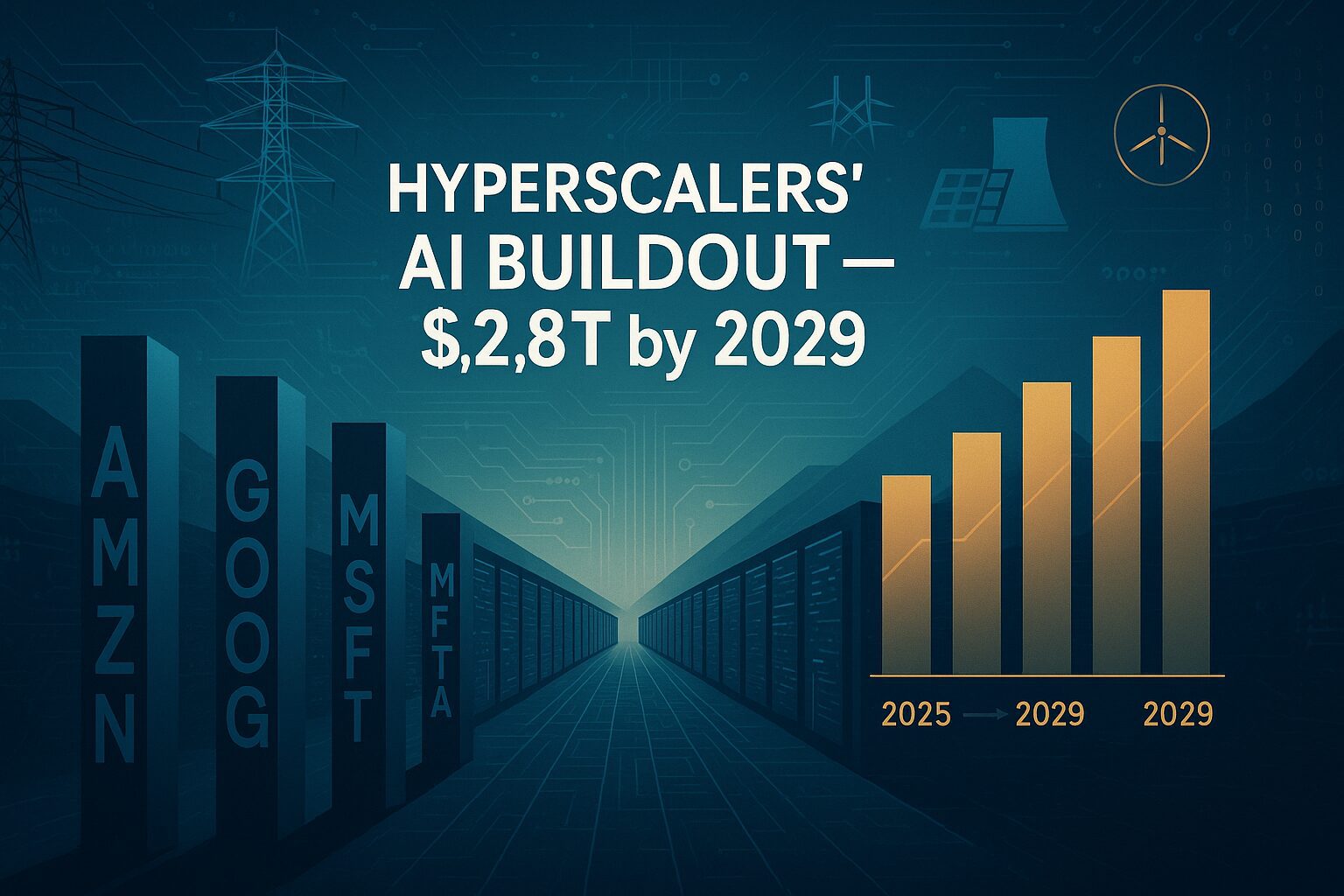
Investment firm Citi lifts its AI build-out forecast: Amazon, Alphabet (Google), Microsoft, and Meta could collectively invest up to $2.8T by 2029, front-loaded with $490B capex by end-2026. The spend hinges on scarce power—~55 GW new capacity—pushing firms to borrow and pressuring free cash flow (Source: Reuters).
Key Facts
- New forecast: >$2.8T AI infrastructure through 2029; prior estimate was $2.3T (Source: Reuters)
- Near-term cadence: ~$490B AI capex by end-2026.
- Power bottleneck: ~55 GW additional capacity needed by 2030 (≈$50B per GW).
- Geography: ~$1.4T of the total in the U.S. alone.
- Funding mix: Shift from profits to debt financing, pressuring FCF.
Short Analysis
Citi’s step-up underscores a super-cycle: GPUs, data centers, networks, cooling, and power become the new strategic moat. The power math is stark—55 GW is utility-scale, implying grid upgrades, long lead times, and permitting risk. Winners span AI chips, accelerators, power equipment, utilities, and specialized data center REITs/operators. Losers: firms unable to secure energy or balance sheets for this spend.
Debt creep matters. If hyperscalers lean harder on borrowing, investors should expect capex-heavy guides and lower near-term FCF—but also durable pricing power in AI cloud and inference services as capacity comes online. Track Q3–Q4 earnings language for “build-ahead-of-demand” signals and any disclosure on power PPAs, on-site generation, and grid interconnect queues.
Call for Information
Are you working on hyperscaler power procurement, grid connections, PPAs, or data-center buildouts? Share insights or documents confidentially via Whistle42.com.