



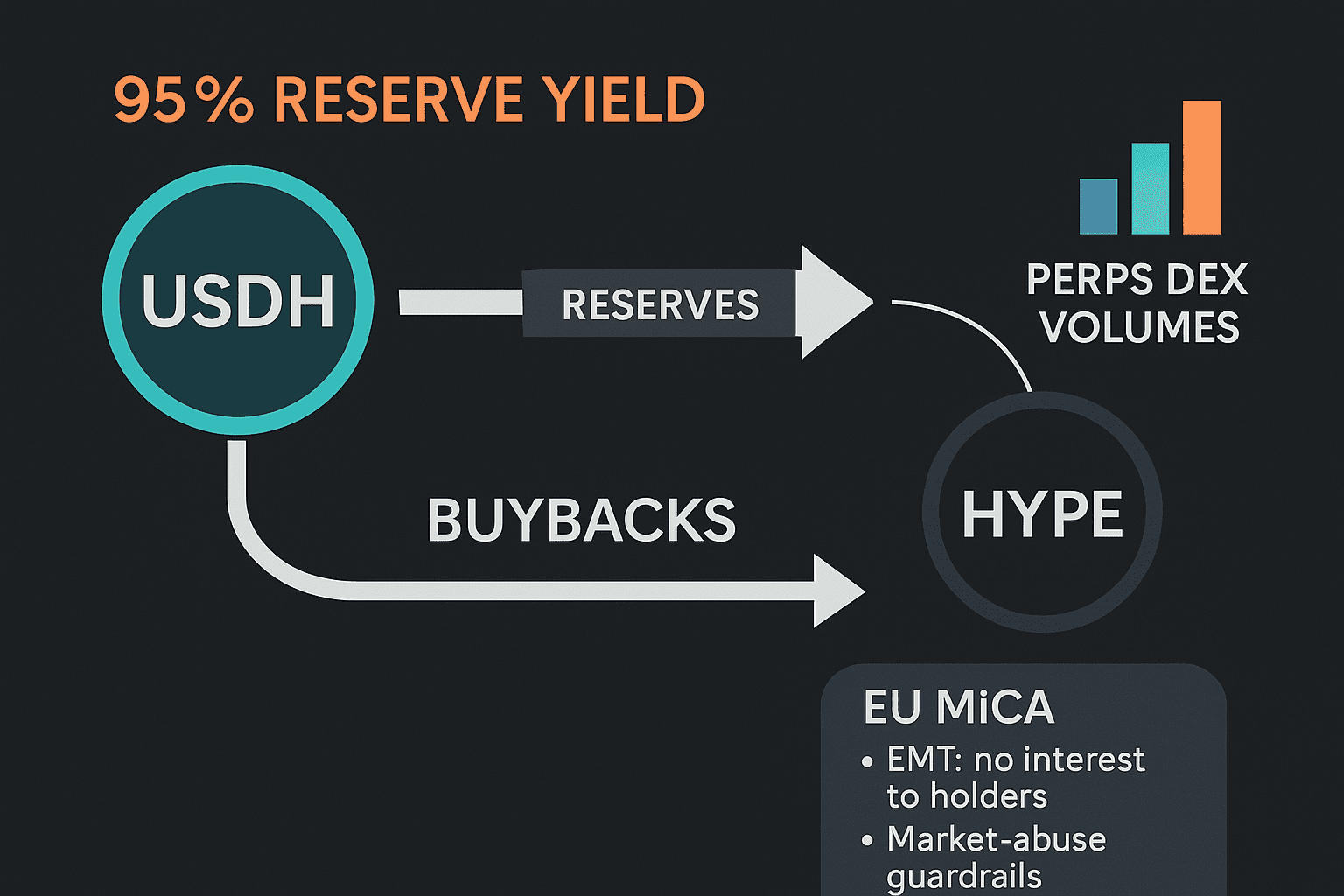
Paxos has proposed USDH, a Hyperliquid-first stablecoin where ~95% of reserve interest (e.g., T-bill yield) would be used for programmatic buybacks of HYPE, Hyperliquid’s utility token. The announcement coincided with a ~3% pop in HYPE as the market priced in a structural bid for the token. If adopted and scaled, USDH could create a powerful “stablecoin yield → native-token demand” loop around Hyperliquid’s already dominant on-chain perps venue.
EU investors should note: for EU usage, USDH must satisfy MiCA e-money token (EMT) requirements (issuer type, whitepaper/notifications, redemption, no interest to holders), and MiCA Title VI market-abuse rules would apply to any systematic buybacks in EU trading venues. (Sources: CointelegraphODaily, Coinpaper, Blockonomi, 21shares.com, service.betterregulation.com, esma.europa.eu).
Issuers & Players
- Paxos — NYDFS-regulated trust company; issuer of USDP and former BUSD partner (BUSD minting halted in 2023 per NYDFS; 2025 settlement reached). Proposal claims USDH would be compliant with MiCA and the US GENIUS Act framework (Sources: Department of Financial Services, Reuters, theblock.co, TradingView)
- Hyperliquid (HYPE) — Order-book DEX + L1 focused on perpetual futures. Multiple analyses show outsized share of on-chain perps volume in 2024–25 (estimates 75–80% share, $1.5T+ cumulative volume). A hallmark is extreme efficiency: public interviews and reports frequently cite a core team of ~11 people, fueling the “Binance-on-chain” narrative (Sources: OKXMedium+1, Medium).
The DEX/Perps Segment (Where USDH Would Live)
Perpetual futures or perps (no expiry; funding payments align perp to spot) have become crypto’s core derivatives rail. In 2025, decentralized perps volume reached ~$2.6T, with daily peaks in the tens of billions. Hyperliquid and dYdX lead; GMX/Aevo trail. Hyperliquid’s edge: fast L1, deep market list, aggressive leverage, and a CEX-like UX—all on-chain. 21shares.comNFT Evening
What USDH Actually Proposes
- Design: A Hyperliquid-native stablecoin (USDH) issued by Paxos; ~95% of reserve yield used for ongoing HYPE buybacks and redistribution to ecosystem stakeholders (validators/users/partners). USDH governance by validator selection is flagged in reports (Sources: Cointelegraph, ODaily, TradingView).
- Market reaction: Coverage notes an immediate ~3% rise in HYPE post-announcement; live trackers show HYPE trading in the high-$40s area around the news cycle (Sources: Coinpaper, CoinMarketCap).
Why This Is a Big Deal (Mechanics & Flywheel)
- Value capture: Instead of paying yield to USDH holders (barred under MiCA for EU EMTs), the reserve yield is rerouted to HYPE—creating persistent buy-side flow if USDH’s float scales. It’s a seigniorage-style flywheel that fortifies the L1/DEX token rather than the stablecoin itself (Sources: service.betterregulation.com).
- Strategic moat: If USDH gets serious adoption on Hyperliquid (quote currency, collateral, fees), the buyback stream could reduce circulating HYPE (depending on burn/lock policy) and tighten the Hyperliquid moat against rival perps DEXs (Sources: 21shares.com).
Regulatory Context (EU)
- USDH in the EU = EMT under MiCA. For EU distribution/use, the issuer must be an EU credit/e-money institution (or appropriately passported), publish the required EMT documentation/notifications, and comply with redemption at par and no interest to holders (Article 50). Using reserve income for HYPE buybacks sidesteps interest to holders, but execution/disclosure matter. (Sources: eur-lex.europa.eu; eba.europa.eu, service.betterregulation.com).
- HYPE (utility token) & market integrity. MiCA Title VI prohibits market manipulation and insider dealing in crypto-asset markets. A standing buyback program linked to USDH’s reserve yield must be run with clear policies, blackouts, ADV caps, and periodic disclosures to avoid manipulation optics—especially if activity touches EU-admitted venues/CASPs (Sources: esma.europa.eu, paulhastings.com).
- MiCA vs. MiFID II. MiCA excludes MiFID financial instruments; HYPE/USDH are not MiFID instruments per se. (If an instrument offered rights to revenue/dividends, it would be a security under MiFID II and outside MiCA—your separate security-token idea would sit there) (Sources: esma.europa.eu+1, amf-france.org).
Opportunities
- Structural demand driver: If USDH supply scales, buyback flow grows—potentially a persistent positive impulse for HYPE liquidity and price discovery (Sources: Cointelegraph)
- On-chain dominance compounder: Hyperliquid already commands share; a native EMT can reduce USDC dependence, deepen markets, and further attract market makers/liquidity takers (Sources: 21shares.com)
- Issuer credibility: Paxos’ regulated pedigree (NYDFS supervision; orderly BUSD wind-down; recent settlement/SEC matter resolved) may soothe counterparty concerns if EU structuring aligns with MiCA (Sources: Department of Financial Services, Reuters).
Risks
- Regulatory execution in the EU. “MiCA-compliant” claims must map to actual EU EMT authorisation and whitepaper/notification; otherwise EU platforms/investors can’t rely on it. ESMA has warned CASPs about misleading compliance marketing (Sources: Reuters).
- Market-abuse optics. A large, predictable buyback stream can draw manipulation scrutiny if not transparently governed (timing, size, counterparties) (Sources: esma.europa.eu).
- Concentration & key-person risk. Hyperliquid’s tiny team supercharges agility but heightens operational dependence; any shock to infra/governance could ripple through the perps market (Sources: Medium).
- Adoption risk. USDH must win share against entrenched EMTs (USDC/EUR-EMTs) and competing proposals (reports mention Frax/Agora bids) (Sources: AInvest).
Market Impact (What to watch next)
- Validator vote / issuer selection and whether USDH gains base-pair status on Hyperliquid.
- EU structuring: Will there be an EU EMI/credit-institution issuer (or passport) for EU usage?
- Policy docs: Buyback governance—blackout windows, ADV caps, monthly reporting—to align with MiCA Title VI expectations.
- HYPE data: circulating supply trends, treasury/validator distributions, and realized buyback volumes post-launch.
Actionable Takeaways
- Traders: Expect liquidity and funding-rate dynamics to shift if USDH becomes a primary quote asset; the buyback stream may reduce HYPE float over time (if burned/locked), affecting perp basis.
- Institutions: Before using USDH in Europe, verify EMT status (issuer entity, whitepaper/notification, redemption, safeguarding). Treat “compliant” claims as non-binding marketing until documentation is posted.
- Builders/venues: If mirroring the model, keep the reserve-yield → buyback linkage discretionary, publish policy + disclosures, and avoid “backing/pegged” claims to stay out of EMT interest prohibitions and market-abuse crosshairs.