



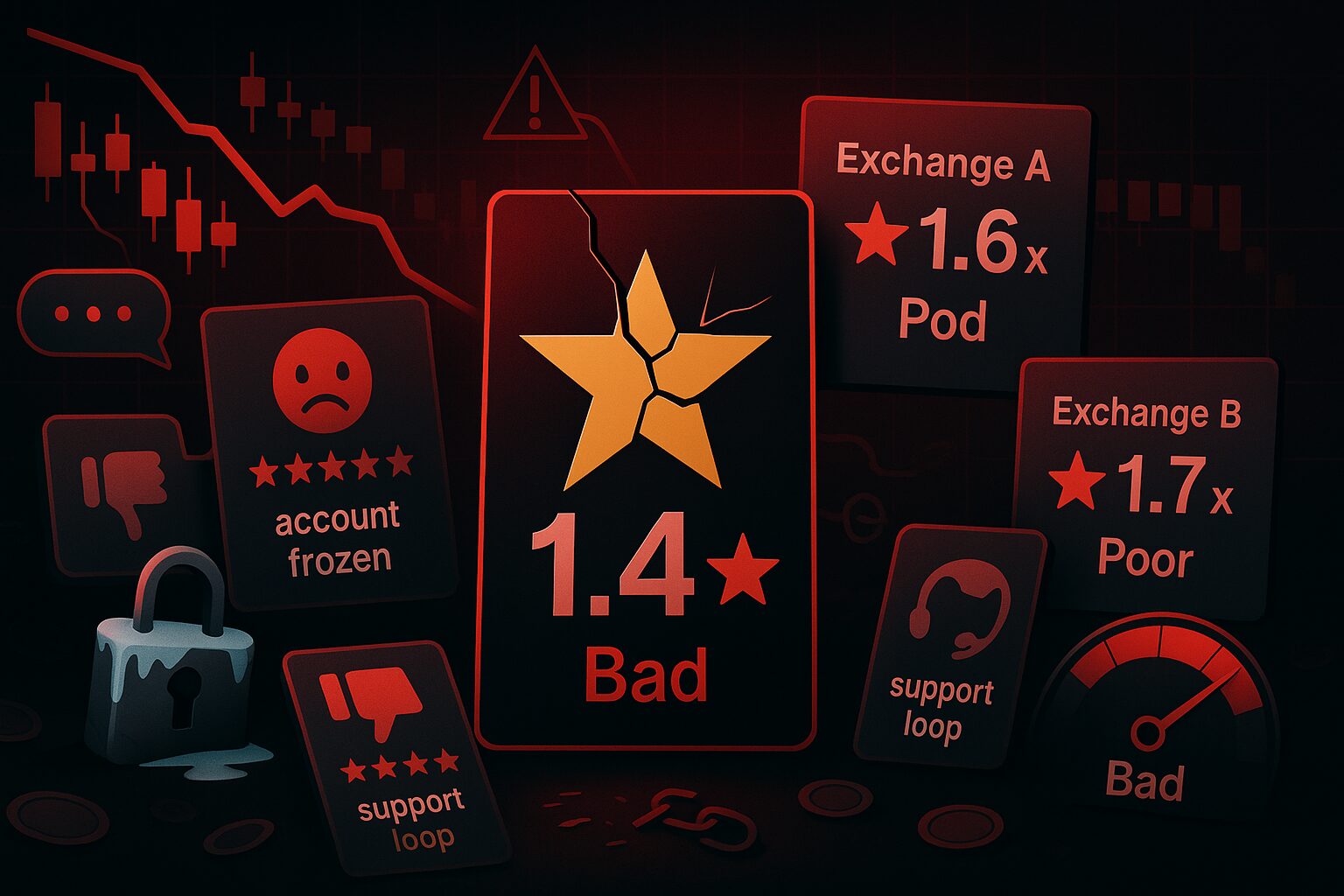
Trustpilot is issuing a brutal verdict on crypto exchanges: Binance 1.4, Kraken 1.6, Bitstamp 1.7, Gemini 1.4, Blockchain.com 2.1—dominated by frozen-account horror stories and support dead ends. Only Coinbase and Bitpanda (3.9, Great) and Bybit (3.4, Average) escape “scam-level.” Fintechs like Revolut (4.6, Excellent) and Wise (4.3) show how far crypto’s CX still lags.
Snapshot: what the ratings say today
- Binance: ~1.4/5 (“Bad”) across ~6k reviews (Source: Trustpilot)
- Kraken: ~1.6/5 (“Bad”) across ~3k reviews (regional pages show the same) (Source: Trustpilot)
- Gemini: ~1.4/5 (“Bad”) (1k+ reviews) (Source: uk.trustpilot.com).
- Bitstamp: fragmented profiles: bitstamp.net ~1.6/5 (“Bad”) (~990 reviews) and bitstamp.com ~1.2/5 (“Bad”) (~100 reviews) (Source: Trustpilot)
- Blockchain.com: ~2.1/5 (“Poor”) (~7k reviews) (Source: Trustpilot).
By contrast, the best-scoring large players:
- Coinbase: 3.9/5 (“Great”) (~20k reviews) (Source: Trustpilot)
- Bitpanda: 3.9/5 (“Great”) (~14k reviews) (Source: Trustpilot)
- Bybit: 3.4/5 (“Average”) (~6–7k reviews) (Source: Trustpilot)
Fintechs that also let customers trade crypto materially outperform:
- Revolut: ≈4.5–4.6/5 (“Excellent”) (≈300k reviews) (Source:Trustpilot).
- N26: ≈3.8/5 (“Great”) (~38k reviews) (Source: Trustpilot).
- Wise: ≈4.3/5 (“Excellent”) (270k+ reviews) (Source: ca.trustpilot.com).
Bottom line: With the partial exception of Coinbase/Bitpanda/Bybit, customer sentiment toward major crypto exchanges on Trustpilot is scam-level.
What the worst reviews complain about (recurring patterns)
- Frozen accounts & withheld funds for weeks or months. Large volumes of reviews detail “under review” holds, blocked withdrawals, or P2P escrow disputes; customers say support loops them through canned replies. Examples are visible across Binance and Blockchain.com pages.
- Support that feels non-existent (or bots only). Users report ticket ping-pong and AI chat walls before a human intervenes—again most evident on Binance pages.
- Entity maze & jurisdiction confusion. Complaints from EU users about not knowing which Binance entity actually holds their funds or handles disputes—symptomatic of global restructuring and de-risking.
- Withdrawal frictions & KYC re-verification. “Re-KYC after deposit,” “old card proof,” or mid-flow compliance prompts are common flashpoints.
- P2P marketplace risks. Disputes over releases/escrow and chargeback exposure feed “scam” narratives on Binance’s P2P.
- Bitstamp fragmentation. Two public Trustpilot profiles split reviews (bitstamp.net vs bitstamp.com), but both still sit in “Bad” territory.
- Methodology caveat (review gaming). Trustpilot has had to police fake or manipulated reviews (including crypto). It removed swathes of suspect content and has even disabled a Binance TrustScore previously—so the signal is imperfect, albeit still damning at scale (Source: The Guardian).
Why are crypto exchanges so poorly rated? A working hypothesis
A. Structural compliance friction > catastrophic CX.
Exchanges operate under intense AML/CTF, sanctions, and fraud risk. Their default defense—automated risk engines + sweeping account reviews—freezes funds and blocks withdrawals first, investigates later. Without fast, human-grade triage, this feels indistinguishable from confiscation to retail users. The reviews show that time-to-resolution (not just freezes) drives rage.
B. Product-model risk: P2P & high-velocity trading.
P2P fiat ramps (escrow disputes, chargebacks) and leverage products create more disputes and more compliance flags than e-money style payments. That naturally increases suspensions and refunds friction relative to neobanks/EMIs.
C. Underinvestment in human support relative to user scale.
Crypto exchanges scaled globally with thin licencing per market and outsourced/AI-heavy support—the wrong mix when freezing someone’s money. Reviews repeatedly cite bot loops and delayed human escalation.
D. Entity sprawl and governance debt.
Multiple legal entities, migrations, and compliance clean-ups leave customers unsure who is responsible for what. That confusion compounds disputes and fuels “scam” accusations.
E. Review-platform dynamics.
Angry customers post more often, and some firms manipulate reviews. Even with that caveat, the volume and consistency of “frozen funds + no support” themes across thousands of reviews suggest a genuine sector-wide CX problem, not merely review bias.
F. Why fintechs score better.
Revolut/Wise/N26 run bank/EMI-like flows with clearer ex-ante risk scoring, fewer P2P disputes, and in-app case handling norms; they appear to have invested earlier in operational CX and communications, and it shows in “Excellent/Great” TrustScores at scale.
Analyst view: what this means
- For regulators: These ratings are a real-time barometer of operational and consumer-protection failings—chiefly around fund accessibility and effective redress. Supervisors should scrutinize (i) time-to-resolution SLAs for freezes, (ii) P2P dispute handling, (iii) clarity about the responsible legal entity, and (iv) adequacy of human support when funds are restricted. The Trustpilot record supplies abundant, concrete case narratives.
- For exchanges: The reputational gap vs. fintechs is stark. The fastest win is not another marketing campaign—it’s SLAs + escalation ladders for frozen-funds tickets, transparent case status, and entity-level accountability in the EU/UK/US. Until that’s fixed, the “scam-level” perception will persist and hurt licensing efforts.
- For consumers: Ratings don’t prove fraud, but they do highlight predictable pain points. If you value recoverability and response times, the data suggest sticking to providers with Great/Excellent TrustScores—or at minimum, testing small withdrawals before trusting a platform with material balances.
Notes on data & limitations
Trustpilot ratings change and can be gamed; where possible we referenced the live company pages (some vary by domain/region) and, for Revolut/Wise, corroborating company disclosures that mirror the Trustpilot score bands. Treat these as directional, not absolute; the pattern—crypto exchanges cluster at “Bad/Poor,” leading fintechs at “Great/Excellent”—is robust across sources as of 29 Oct 2025.